
One monitoring method. Three applications.
Proven on real robot data: 2,122 recordings from a six-axis arm across 12 physical fault types. Ahead of six of seven published baselines, with about 2,800× fewer retained values and no learned weights.
Explore robot condition monitoring, LLM pipeline monitoring and RL agent monitoring. We help teams pilot, tailor and license information monitoring in their own systems.
Drift: What Accuracy and Reward Do Not Show
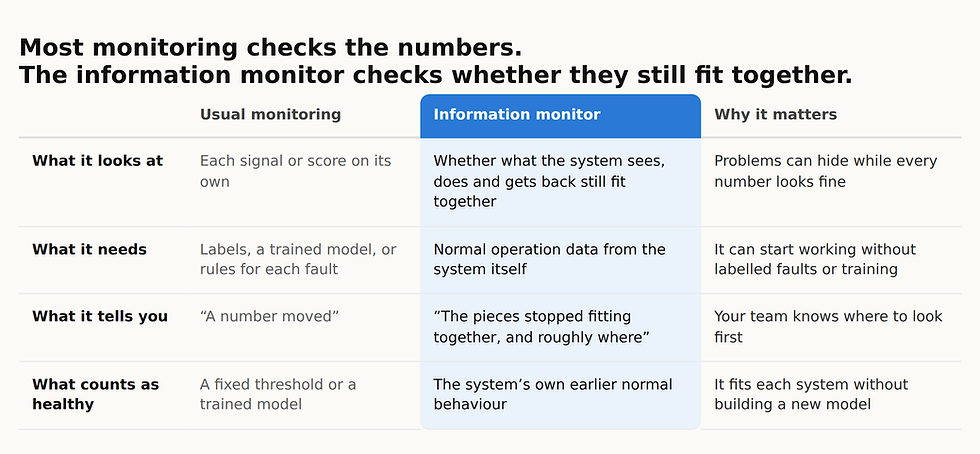
Scores can look normal while a system drifts. The information monitor checks whether what the system sees, does and gets back still fit together, using only data the system already produces.


ABOUT US
Measuring Drift with Information Theory
Information theory measures how much one signal tells you about another, with no model of the system needed. We use it to track how strongly inputs, actions and outcomes still inform one another, against the system’s own healthy baseline.
The Information Digital Twin (IDT)
Drift Detection for Machines and AI

The IDT is our drift detector for autonomous systems. It runs alongside your robot, RL agent or LLM pipeline, reads only what goes in and what comes out, and computes information-theoretic metrics from that stream.
When drift appears, it gives a first indication of where, on the sensing side or the acting side, so your team knows where to look.

Drift Detection for Human-Machine Teams
The HDT applies the same information monitoring to the interaction between a human operator and their system, in cockpits, control rooms or clinical settings.
It reads the interaction stream: actions, observations and outcomes. When operator and system stop predicting each other, the HDT flags the drift.
Systems can then simplify the interface or alert a supervisor while the situation can still be recovered.